
Credit Scores Louisville Kentucky FHA KHC VA Conventional mortgage
Louisville, Ky Mortgage Lenders: Credit Scores FHA Loans Louisville Kentucky KHC First Time Home Buyer Credit ScoreLouisville, Ky Mortgage Lenders: Credit Scores FHA Loans Louisville Kentucky KHC First Time Home Buyer Credit Score

What Credit Score do You Need to qualify for a FHA VA KHC Kentucky Mortgage Louisville Kentucky
Wat Credit Score do You Need to Buy a Home?
When it comes to mortgages and credit scores, there are two really important questions to ask:
–What credit score do I need to qualify for a mortgage?
–What credit score do I need to get the lowest interest rate on a mortgage?
These different but related questions are important if you are looking to buy a home. And the second question is particularly important. With a high FICO score, you can literally save tens of thousands of dollars in interest over the life of a home loan. So let’s take a look at both questions. And if you don’t know you score, be sure to get you free credit score.
What credit score do you need to qualify for a mortgage?
The first thing to keep in mind is that qualifying for a mortgage involves a lot more than just a credit score. While your FICO score is a very important ingredient, it is just one factor. Lenders also look at your income and level of debt, among other things.
As a rule of thumb, however, a credit score below 620 will make buying a home very difficult. A FICO score below 620 is considered sub-prime. In the past there were mortgage companies that specialized in sub-prime mortgages. Because of the challenges in the credit market over the last year or so, however, sub-prime loans have become difficult if not impossible to obtain.
A FICO score between 620 and 650 is considered fair to good credit. But keep in mind, this range of credit scores does not guarantee you will qualify for a mortgage, and if you do qualify, it won’t get you the lowest interest rate possible. Still, to buy a home aim for a score of at least 620, recognizing that other factors weigh in the decision and that some banks may require a higher score.
What credit score do you need to get a low rate mortgage?
It use to be that a score of about 720 would yield the lowest mortgage rates available. Today, the best rates kick in with a FICO score of 760. And interest rates go up significantly as your credit score drops. To give you an idea, the following table shows current rates by credit score and calculates a monthly principal and interest payment based on a $300,000 loan:
FICO Score & 30-year Fixed Rate Mortgage
FICO Score APR Monthly Payment
760-850 4.643% $1,546
700-759 4.865% $1,586
680-699 5.042% $1,618
660-679 5.256% $1,658
640-659 5.686% $1,739
620-639 6.232% $1,844
Of course, the interest rates change daily, but the above table gives you an idea of the importance of a high score when you apply for a mortgage.
Contact me today and I will pull your credit for free. 502-905-3708 or email me at kentuckyloan@gmail.com
Posted by kentuckyloan at 12:41 PM Email This BlogThis! Share to Twitter Share to Facebook Share to Google Buzz
Labels: Credit Score First Time Home Buyer Louisville Kentucky KHC, FHA Loans, FHA Loans Kentucky Housing First time home buyer
Louisville, Ky Mortgage Lenders: Credit Scores FHA Loans Louisville Kentucky KHC First Time Home Buyer Credit Score

Credit Score Requirements for Kentucky Mortgage Loans in 2025: USDA, FHA, VA, and Conventional
If you’re planning to buy a home in Kentucky, one of the first questions you’ll have is: What credit score do I need to qualify for a mortgage? The answer depends on the type of loan program you choose—USDA, FHA, VA, or Conventional (Fannie Mae/Freddie Mac).
Understanding how credit scores impact your loan eligibility is key to securing the best financing. Below, we’ll break down the minimum credit score requirements for each loan type, along with tips for borrowers with less-than-perfect credit.
Why Credit Scores Matter for Kentucky Homebuyers
Your credit score is one of the biggest factors lenders use to decide whether to approve your loan. While income, employment history, and debt-to-income ratio also matter, your score plays a major role in:
-
Mortgage program eligibility
-
Interest rate and monthly payment
-
Down payment requirement
-
Overall loan approval
Most Kentucky lenders use the FICO® Score model, which ranges from 300–850. The higher your score, the less risky you appear, which translates into lower rates and better loan terms.
Credit Score Requirements by Loan Type in Kentucky
USDA Loan (Rural Housing)
-
Minimum Score: 580+ accepted; 640 preferred by most lenders
-
Down Payment: 0% (no money down)
-
Other Factors: Property must be in a USDA-eligible rural area; income limits apply
The USDA loan is one of the best options for Kentucky first-time homebuyers who qualify, thanks to zero down payment requirements. A 640+ score makes for smoother automated approval, but borrowers with scores as low as 580 can often qualify with manual underwriting.
FHA Loan (Federal Housing Administration)
-
Minimum Score: 500 with 10% down; 580+ with 3.5% down
-
Down Payment: As low as 3.5%
-
Other Factors: Flexible on credit history, but lenders may add stricter “overlays”
FHA loans are a strong choice for Kentucky homebuyers with lower credit scores or limited savings. While the FHA allows scores down to 500, most lenders in Kentucky prefer a 620 or higher for smoother approvals and better rates.
VA Loan (Veterans Affairs)
-
Minimum Score: No official minimum; 620 preferred by most lenders
-
Down Payment: 0% (no money down)
-
Other Factors: Available only to eligible veterans, active-duty service members, and surviving spouses
The VA loan is one of the most powerful benefits for Kentucky’s military families. While VA doesn’t set a minimum score, most lenders look for at least 580+, with 620 giving you the strongest chance of approval.
Conventional Loan (Fannie Mae & Freddie Mac)
-
Minimum Score: 620
-
Down Payment: As low as 3-5% for first-time buyers
-
Other Factors: Stronger credit = better rates and mortgage insurance terms
Conventional loans are ideal for borrowers with solid credit histories. With a 620 score you can qualify, but higher scores (720+) unlock the best rates and lowest costs.
Credit Score Comparison Chart for Kentucky Mortgages
| Loan Type | Minimum Score | Preferred Score | Down Payment |
|---|---|---|---|
| USDA Loan | 580+ | 640 | 0% |
| FHA Loan | 500 / 580+ | 620+ | 10% / 3.5% |
| VA Loan | No Minimum | 620 | 0% |
| Conventional | 620 | 720-740+ | 3-5%+ |
What If Your Credit Score Is Too Low?
Many Kentucky borrowers think they need “perfect” credit to buy a home—that’s not true. Options exist even if your score isn’t where you’d like it to be. Here’s how to improve your chances:
-
Review Your Credit Report – Check for errors or old accounts dragging down your score.
-
Pay Down Balances – Lower credit utilization can boost your score quickly.
-
Avoid New Debt – Limit credit inquiries and new accounts before applying.
-
Work With a Mortgage Professional – Lenders like me can help create a custom plan to qualify.
The Bottom Line for Kentucky Borrowers
Each loan program in Kentucky has different credit score requirements:
-
USDA and VA loans are great zero-down options if you meet eligibility guidelines.
-
FHA loans provide flexibility for lower credit scores.
-
Conventional loans reward strong credit with the best long-term savings.
No matter your situation, there’s usually a pathway to homeownership. The key is knowing your options and working with an experienced loan officer who understands Kentucky’s mortgage programs.
Start Your Home Loan Journey Today
If you’re wondering whether your credit score is high enough to buy a home in Kentucky, let’s talk. I’ll review your credit, explore all loan options, and put together a step-by-step plan to get you approved.
Joel Lobb – Senior Loan Officer, EVO Mortgage
NMLS #57916 | Company NMLS #1738461
📞 (502) 905-3708 | ✉️ kentuckyloan@gmail.com
Serving all 120 counties in Kentucky
Equal Housing Lender | Not endorsed by any government agency
All loans subject to credit approval & program availability.
|
How to Rebuild Your Credit
Tips for Raising Your Credit Score
• Pay your bills on time
• If you have missed payments, get current and stay current
• Be aware that paying off a collection account will not remove it from your credit report
• If you are having trouble paying your bills, contact your creditors or see a legitimate credit counselor
• Keep balances low on credit cards and other revolving credit
• Do not have too many credit cards and do not use them maximum credit limit on any of them
• Pay off debt rather than moving it around
• Don’t close unused credit cards as a short-term strategy to raise your score
• Don’t open a number of new credit cards that you don’t need just to increase your available credit
• If you have been managing credit for a short time, don’t open a lot of new accounts too rapidly
• Do your rate shopping for a given loan within a focused period of time
• It is OK to request and check your own credit report
• Apply for and open new credit accounts only as needed
• Have credit cards – but manage them responsibly
• Closing an account doesn’t make it go away
Building a Non-traditional Credit History
If you’d rather not get a credit card or loan, you can create a “nontraditional credit history” instead
— Joel Lobb
Email – kentuckyloan@gmail.com
 Call/Text – 502-905-3708 Call/Text – 502-905-3708www.mylouisvillekentuckymortgage.com Evo Mortgage Kentucky Mortgage Loan Expert For Kentucky FHA, VA, USDA, Fannie Mae and KHC Down payment Assistance Loans |


Yes that’s right, 620 is the magic credit score for getting a mortgage loan!
If you are looking any other loan program ie non conventional meaning an FHA loan, a USDA mortgage, a VA mortgage or even Home Path Financing you need to have a least a credit score of 620.
A rapid rescore can fix your credit score in a hurry
When it comes to getting a home loan, does your credit report and credit score really matter? Can you use the free credit score you got off the internet to apply for a loan? What if your credit score is low, can you get a mortgage? What if it is high, will you get a better interest rate? And what the heck is FICO?
Here’s the good news. I am here to explain things simply and clearly. Step by step I will walk you through all things credit. When I am done, you’ll know what you need to know to understand how credit impacts your ability to get a mortgage so you can make smart home buying decisions.
Below are the important items I will discuss:
- What is a credit report?
- What do mortgage lenders use to determine my credit score?
- What does FICO stand for?
- What determines my FICO score?
- What’s a good FICO score?
- What if my FICO score is below 620?
- Can I get a copy of my credit report?
- Ah Ha! Now I understand all things credit and I’m this much closer to owning my home!
What is a credit report?
A credit report record’s your credit history including information about:
- Your identity: name, social security number, date of birth and possibly employment information.
- Your existing credit: credit card accounts, mortgages, car loans, students loans etc.including credit terms, how much you owe, and your payment history.
- Your public record: Judgments against you, tax liens or bankruptcies.
- Recent Credit Inquiries: Requests for your information from companies extending credit such as credit card companies, auto loans, etc.
Be aware, credit card companies, car companies and mortgage lenders use slightly different models to determine credit risk. Today we are focusing on Mortgage related credit.
How do lenders calculate my credit score?
Your credit score is the key to your castle. Your home is most likely the most expensive purchase you will ever make. Therefore, when buying a home, lenders use a different system for assessing risk than credit card companies or even auto loan companies use.
Mortgage lenders use a comprehensive system of checking credit called a Residential Mortgage Credit Report (RMCR), commonly called a “Tri-Merge” report. The RMCR report combines your three credit reports from the three national credit bureaus, Equifax, Experian, and TransUnion. Each credit reporting agency calculates your credit score or FICO Score differently. Therefore, pulling from all three bureaus gives lenders a more complete picture of your credit behavior.
Once pulled, lenders use the average of these three scores, usually the middle score, to determine loan qualification and interest rate. For example, if Equifax gives you a 720, Experian a 730 and TransUnion a 740, the lender will use the 730 FICO Score to help determine the terms of your mortgage. If you are applying for a loan jointly, your partner’s three reports will also be pulled.
What does FICO stand for?
FICO stands Fair, Isaac and Company. Over 25 years ago, lenders began using FICO’s scoring model, or algorithm, to fairly and more accurately determine a person’s credit risk. Since it’s inception, FICO’s continually updates its’ algorithms to reflect more current lending trends and consumer behaviors. Today, FICO Scores are used by over 90% of enders. Importantly, your FICO score can impact your loan interest rates, terms, approvals and more.
What determines my FICO score?
A Mortgage FICO score is determined by an algorithm that generally looks at five credit factors including payment history, current level of indebtedness, types of credit used, length of credit history and new credit accounts.
What’s a good FICO score?
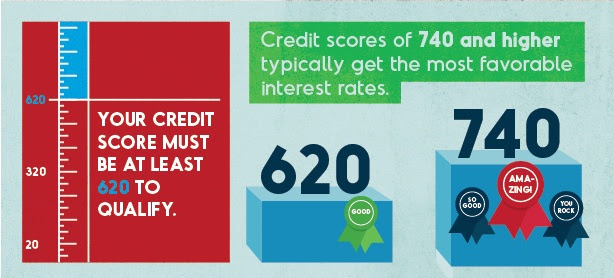
To qualify for a conventional loan, most Mortgage lenders require a FICO score of 620+. The best interest rates go to borrowers with a 740+ FICO score. For each 40 point drop, borrowers can expect to see a slightly higher interest rates by about 0.2 percentage points. If a borrower drops below 660, the increase is likely to be twice as big, a 0.43 percentage point increase. If your credit score is below 620, it is very difficult to get a conventional loan in today’s marketplace. However, don’t be discouraged. You may still be able to buy a home.
What if my FICO or credit score is below 620?
If your score is below 620, you may still be able to buy a home. There are several options:
- Put more money down. Some lenders offset a weak credit score with a higher down payment. A higher down payment gives you more equity in your home, lowering the lender’s risk.
- You may qualify for a non conventional government issued loan such as an FHA, Veterans Affairs and/or U.S. Department of Agriculture loan which have less stringent lending requirements.
-
You may work to get that credit score up!
-
Correct any errors on your report. Analyze your credit items line by line. If you notice a mistake, dispute it right away with either the credit bureau providing the report or the company that providing the incorrect information to the credit bureau.
-
Make all your payments on time. Late payments are the No. 1 way to lower your credit score.
-
Pay down revolving debt. Keeping your credit balances low helps to raise your score.
-
Sit back and relax. As long as you’re paying down debt and making payments on time, your credit score will eventually rise on its own.
-
Can I get a copy of my credit report after a lender has pulled it?
Yes! In fact, you can get one free credit report every twelve months from each of the nationwide credit bureaus—Equifax, Experian, and TransUnion. You may also purchase your credit score at any time from any of the credit bureaus. Some Mortgage lenders will tell you your score when you apply for a loan or even give you a copy of your report but they are not required to do so. However, if a lender denies you credit, under the Fair Credit Reporting Act (FCRA) you are entitled to a free copy of your personal credit report if you have received notice that in the past 60 days you have been declined credit.
You ALWAYS get a free copy of your credit report from me.
I believe in transparency. When you apply online, we will pull your credit from all three agencies and give you a free copy. You don’t even have to ask for it. It will be in your inbox for your review at the same time we get it for review. It’s part of the Approved Buyer’s Cert (ABC) process. I will give you an underwritten mortgage approval. Better than a pre-approval based on assumptions, it’s an actual mortgage approval. Know what you are approved to purchase even before you find the home of your dreams. Simple and straightforward.
Lastly, There are some programs offered to home buyers here locally that if they have a credit score higher than 660, you can do a no money down home loan with no mortgage insurance. This Is good for buyers they have no money to put down, but not have to go with a FHA loan and pay mortgage insurance for life of loan.
If your credit scores are a little low now, we can look at doing some improvement to your scores through the rapid-rescoring program we offer free of charge as I described above. It seems like you have a handle on this with your student loan error, so it may be best to let you work on this.
 Call/Text – 502-905-3708
www.mylouisvillekentuckymortgage.com
911 Barret Ave., Louisville, KY 40204
Evo Mortgage
Company NMLS# 1738461
Personal NMLS# 57916
Kentucky Mortgage Loan Expert For Kentucky FHA, VA, USDA, Fannie Mae and KHC Down payment Assistance Loans
2 thoughts on “Credit Score Requirements for Kentucky Mortgages”